The corners market is one of the most underrated betting opportunities in football. Most punters focus on match results and goals — but experienced bettors have long understood that corners follow predictable tactical patterns, and the over/under 7.5 corners market is where that knowledge becomes most useful. This article explains what over/under 7.5 corners means, how the market works on SportyBet, and — more importantly — a specific tactical strategy for predicting it that goes beyond generic advice.
What does over/under 7.5 corners mean?
In football betting, the corners market asks you to predict the total number of corner kicks awarded in a match — to both teams combined — during the 90 minutes of normal time. Extra time and penalty shootouts are not included.
The 7.5 line works as follows:
- Over 7.5 corners — you are predicting that the match will produce 8 or more total corners. If the final corner count is 8, 9, 10, 12, or any number above 7, your over bet wins.
- Under 7.5 corners — you are predicting that the match will produce 7 or fewer total corners. If the final corner count is 7, 6, 5, or lower, your under bet wins.
The “.5” is used deliberately so there is never a push — there is no such thing as exactly 7.5 corners in a football match. Every match lands cleanly on one side of the line, which means there are no refunds and no void bets. The market always produces a winner and a loser.
7.5 is one of the most popular corner lines offered by bookmakers like SportyBet because it sits close to the statistical average for most top-flight football matches. The average corner count in the Premier League across recent seasons falls between 9 and 11 per match — which means over 7.5 lands more often than it misses in standard attacking encounters. However, the specific circumstances of each match — tactics, team styles, and the competitive dynamics between the two sides — shift that average significantly in either direction. That is where the real analytical edge lives.
Over 7.5 corners strategy — the bus parking principle
This is the most reliable indicator for backing over 7.5 corners in a match, and it comes down to one specific tactical dynamic: when one team parks the bus, the other team wins corners for a living.
Take a match like Manchester United vs Coventry. Coventry, the weaker side, will set up in a deep defensive block — two disciplined banks of four, defending the space between the penalty area and the 18-yard box, limiting the central channels, and forcing United wide. United, with their superior attacking quality, will dominate possession and spend the majority of the match operating in and around Coventry’s defensive third. What happens when you have a technically superior team repeatedly attacking into a packed, organised defence?
Corners. Lots of them.
Every blocked cross that deflects out for a corner. Every shot that hits a defender’s shin and spins wide. Every cutback that gets blocked and rolls behind the byline. Every delivery into the box that the goalkeeper punches clear. In a bus-parking scenario, the dominant team’s repeated movement in the opponent’s 18-yard box generates corners continuously. It is not just that United are creating attacks — it is that they are creating attacks against ten men who are defending the width of their own penalty area. The corner count becomes a direct function of how many times the dominant team reaches the attacking third, and a bus-parking setup almost guarantees a high frequency of those entries.
The signal to look for: check whether the weaker team is historically set up to defend deep on the road. A side that has conceded the highest number of corners this season — because they spend most away games in their own half — is your clearest over 7.5 corners indicator when they face a stronger opponent. The dominant team’s quality combined with the weaker team’s defensive posture creates the perfect environment for a high corner count.
Under 7.5 corners strategy — the midfield battle principle
The under market is built on the opposite principle. When two teams are almost equally matched in quality and tactical setup, play concentrates in midfield. Neither side dominates the other’s defensive third long enough to generate repeated corners. The ball moves horizontally and vertically between the two midfields. Attacks break down before they reach the corner-generating zones around the byline. Both goalkeepers are well-positioned because the threat reaches them with less directness and less frequency.
The key condition for under 7.5 corners is that neither team has a significant enough quality advantage to pin the other back for sustained periods. When the head-to-head, form, and tactical profiles of both sides are closely matched, the match effectively becomes a 90-minute contest for midfield control — and midfield control does not produce corners. It produces transitions, half-chances, and a lower-scoring, tighter tactical encounter.
Classic examples of this dynamic include evenly matched derbies, top-four clashes where both managers set up to avoid losing first, and European knockout ties where both sides prioritise compactness. These matches often have low corner counts not because they are boring — but because neither team is able to dominate the other’s final third long enough to force the corner-generating situations that one-sided matches produce naturally.
Applying the strategy — Liverpool vs Manchester City
This weekend’s match between Liverpool and Manchester City is one of the best examples in English football for illustrating both sides of this corner framework. These are two of the most tactically sophisticated sides in the Premier League — similarly matched in quality, both set up to dominate possession, both capable of pressing high and defending compactly when necessary. Neither manager will park the bus. Neither side will spend 90 minutes pinned in their own defensive third. This is exactly the kind of evenly-matched, midfield-intensive tactical encounter that the under corners strategy was built for.
Below are the current SportyBet odds for the corners market in Liverpool vs Manchester City:
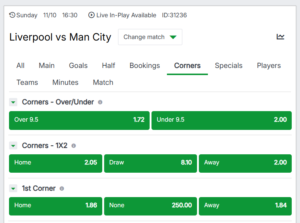
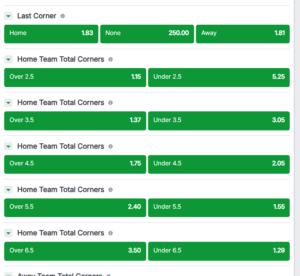
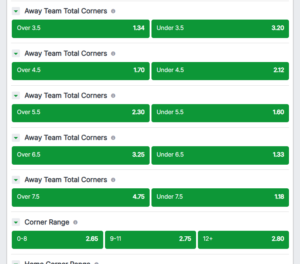
The odds reflect the market’s view of how many corners this specific match is likely to produce. Cross-referencing those prices against the tactical framework — two equally matched sides, likely to contest midfield rather than forcing one another into sustained defensive blocks — gives you a basis for evaluating whether the market is offering value on the under.
What to check before backing a corners market
Beyond the two main strategic principles above, two supporting checks sharpen any corners market prediction:
- Season corner averages. Check how many corners per game each team has averaged both for and against this season. A team averaging four corners per game in attack combined with an opponent averaging five corners conceded per game sets a credible baseline before you apply the tactical filter.
- Head-to-head corner history. Some fixture pairings consistently produce high or low corner counts regardless of current form — due to long-standing tactical tendencies between specific managers or specific playing styles that persist across seasons. Three meetings averaging 13+ corners between the same two sides is meaningful context even if their recent form suggests otherwise.
There’s always a risk with betting
The corners market, like all football betting markets, carries inherent variance. A bus-parking team can nick a counter-attacking goal and shift their own setup. An evenly-matched game can open up late and produce a flurry of late corners as both sides chase a result. The strategies described here are analytical frameworks for identifying higher-probability outcomes — they are not certainties. Use your discretion, stake within your means, and treat every prediction as a researched starting point rather than a guaranteed result.